Table of Contents
Shape functions for an element topology are defined within a shape function struct (e.g., MeshField::LinearTriangleShape). Mapping between the ordering used for those shape functions and those used in the mesh database (currently just Omega_h) is through a mapping struct (see Step 2 - Define the Omega_h Node Mapping Struct below). DOF values are stored in MeshField::Field which needs to be associated with a shape function and mapping via a ShapeField to provide the needed per entity/dof access operators.
Note, as of MeshFields version 1.1.0 only interpolating Lagrange linear and quadratic triangles and tetrahedra are supported. As such, there may be deficiencies in the interface to support other types of shape functions. Please use https://github.com/SCOREC/meshFields/issues to report any problems or ask questions.
This guide walks through every step required to add a new shape function for an Omega_h element topology (edge, triangle, quadrilateral, tetrahedron, etc.). The steps are:
- Define the shape function struct in
src/MeshField_Shape.hpp - Define the Omega_h node mapping struct in
src/MeshField.hpp - Register the shape + mapping in the element factory in
src/MeshField.hpp - Add an Accessor (if needed) in
src/MeshField_ShapeField.hpp - Extend **
CreateLagrangeField** insrc/MeshField_ShapeField.hpp
Background
Terminology
Refer to the Nomenclature section on the main page.
Parametric Coordinates and Node Ordering
MeshFields defines shape functions in a canonical parametric coordinate system that is independent of Omega_h. The node mapping struct (Step 2) bridges the two conventions.
The MeshFields canonical parametric coordinates and node ordering for linear and quadratic triangles and tetrahedrons follows, "The Finite Element Method: Its Basis and Fundamentals", 2013, Zienkiewicz, Taylor, and Zhu.
MeshFields uses  parametric coordinates to specify a location within an element of dimension
  . The redundant coordinate
  is omitted:
| Topology | Parametric coords | Range |
|---|---|---|
| Edge (1D) |  | ![$[-1, 1]$](form_4.png) |
| Triangle (2D) |  | ![$[0,1]^2$](form_6.png) , ,  |
| Tet (3D) |  | ![$[0,1]^3$](form_9.png) , ,  |
Step 1 - Define the Shape Function Struct
Add a new struct to src/MeshField_Shape.hpp inside namespace MeshField.
Required Members
| Member | Description |
|---|---|
numNodes | Total nodes per element |
meshEntDim | Parametric space dimension |
Order | Polynomial order |
DofHolders | Entity types that hold DOFs |
getNodeParametricCoords() | Returns a flat array of node coordinates (length numNodes * meshEntDim) |
getValues(xi) | Returns an array of shape function values at xi (length numNodes) |
getLocalGradients(xi) | Returns a flat array of gradients at xi (length meshEntDim * numNodes, row-major: ![$[\partial N_0/\partial\xi_0, \partial N_0/\partial\xi_1, \ldots, \partial N_d/\partial\xi_0, \partial N_d/\partial\xi_1]$](form_11.png) ) ) |
Optional (needed by quadratic and higher-order shapes):
| Member | Description |
|---|---|
NumDofHolders | Count of entities of each type in DofHolders |
DofsPerHolder | DOFs per entity for each type in DofHolders |
Checking Parametric Coordinates
Use the helper functions declared at the top of MeshField_Shape.hpp to assert that incoming parametric coordinates are in range. This is only a check for outliers as MeshField::ParametricCoordTol is a loose tolerance.
Example: <tt>QuadraticTriangleShape</tt> (from <tt>src/MeshField_Shape.hpp</tt>)
Step 2 - Define the Omega_h Node Mapping Struct
The mapping struct lives in src/MeshField.hpp inside namespace MeshField::Omegah. It translates element-local node indices (as numbered by the shape function) into the on-process mesh entity indices (as numbered by Omega_h) that hold the corresponding DOFs.
Vertex-Ordering Correction
As previously stated, Omega_h numbers vertices and edges within an element differently from the MeshFields canonical ordering used by the shape functions. The Omega_h canonical orderings for simplices are depicted below:
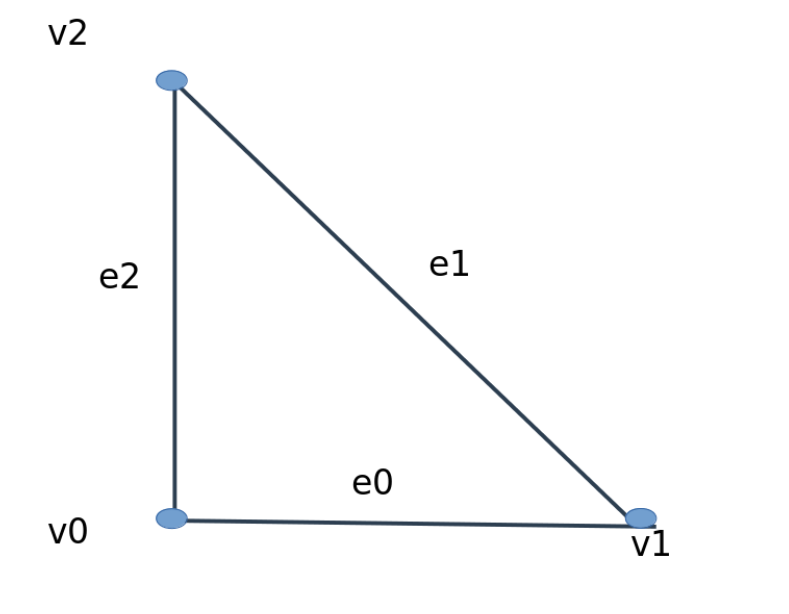
Omega_h triangle ordering.
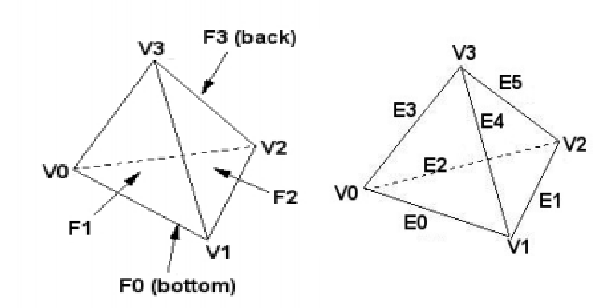
Omega_h tetrahedron ordering.
Meshes composed of hypercubes (quadrilaterals and hexahedrons), pyramids, and prisms are supported by Omega_h, but they cannot be adapted. Version 1.1.0 of MeshFields only supports Omega_h simplices.
The existing linear-triangle and linear-tetrahedron mappings correct for the difference in Omega_h vs MeshFields ordering with a cyclic rotation.
You must determine the correct rotation offset for your topology and DOF holders by comparing the Omega_h canonical vertex/edge ordering (see figures above based on Omega_h_simplex.hpp and the simplex_down_template function) with the node ordering established by getNodeParametricCoords() in your shape struct. It is a good idea to add a unit test that evaluates the shape functions at the parametric coordinates of each node and checks that the value for that node is 1.0 and all others are 0.0.
Interface Requirements
| Member | Description |
|---|---|
Constructor (Omega_h::Mesh &) | Cache connectivity arrays from Omega_h; validate mesh family/dimension |
getTopology() | Return an array of mesh topologies (vertex, edge, triangle, etc...) this mapping applies to |
operator()(LO nodeIndex_in, LO componentIndex_in, LO elementIndex_in, Mesh_Topology elementTopo_in) | Return mapping tuple - see MeshField::ElementToDofHolderMap |
Omega_h Connectivity APIs
| Query | API call |
|---|---|
| Element->vertex connectivity | mesh.ask_elem_verts() -> flat LOs array, stride = simplex_degree(elemDim, 0) |
| Element->edge connectivity | mesh.ask_down(elemDim, 1).ab2b -> flat LOs array, stride = simplex_degree(elemDim, 1) |
| Element->face connectivity | mesh.ask_down(elemDim, 2).ab2b |
Example: <tt>QuadraticTriangleToField</tt> (from <tt>src/MeshField.hpp</tt>)
Step 3 - Register in the Element Factory
Add a new factory function (or extend an existing one) in src/MeshField.hpp inside namespace MeshField::Omegah. The existing getTriangleElement factory (from src/MeshField.hpp) shows the full pattern:
Callers obtain the shape and mapping via structured bindings:
Step 4 - Add an Accessor
An Accessor is a templated struct that provides operator()(entity, node, component, topology) for reading and writing DOF values from the underlying field storage. It is passed as a variadic template argument (Mixins...) to ShapeField.
Two built-in Accessors cover the common cases:
LinearAccessor – for shapes whose DOFs live only at vertices. All calls to operator() are forwarded to a single vertex field regardless of topology:
QuadraticAccessor – for shapes whose DOFs live at both vertices and edges. The operator() dispatches to the vertex field or edge field based on the topology argument:
If your shape introduces DOFs at a new entity type (e.g., triangle faces for a cubic shape), define a new Accessor following the same pattern:
- Add a field member (as done in
QuadraticAccessorforEdgeAccessor edgeField;,) for each new entity type. - Extend
operator()with a branch for the added topology. - List all supported topologies in the
topoarray.
Step 5 - Extend <tt>CreateLagrangeField</tt>
CreateLagrangeField<ExecutionSpace, Controller, DataType, order, dim, numComp>(meshInfo) (in src/MeshField_ShapeField.hpp) is the user-facing factory that allocates field storage and assembles a ShapeField. Add a new if constexpr branch for your shape's order and dim. The steps within that branch are:
- Validate
meshInfocounts for every entity type that holds DOFs (e.g.,meshInfo.numVtx,meshInfo.numEdge). Callfail()if a required count is zero. - Allocate storage – construct a
Controllersized for each DOF-holding entity type. Each field in the controller needs entries fornumEntities * dofsPerHolder * numComp. - Create fields – call
MeshField::makeField<Ctrlr, N>(ctrl)for each field indexNto obtain typed slice objects. - Construct the Accessor – pass the slice objects to your Accessor's constructor (e.g.,
QuadraticAccessor{vtxField, edgeField}). - Return
FieldWithController<Ctrlr, ShapeField<numComp, YourShape, YourAccessor>>{ctrl, ShapeField(meshInfo, accessor)}.
See the existing order == 2 && dim == 2 branch (quadratic triangle) as a concrete reference: